
After a Break Up, Blocking Him Is the Smartest Thing You'll Ever Do
A break up tears your world apart — and every instinct tells you to reach out, check his profile, or just "stay friends." But in 2026, the data, the psychology, and thousands of women's lived experiences all point to the same uncomfortable truth: the no contact rule isn't just effective — it's the highest return on emotional investment you can make.

What Exactly Is the No Contact Rule in 2026?
The no contact rule is simple in theory and brutal in practice: after a break up, you cut off all communication with your ex. No texts. No calls. No "accidental" likes on his Instagram from 47 weeks ago.
But in 2026, it goes further. Modern no contact means blocking him across every platform — Instagram, TikTok, Spotify (yes, Spotify), and even LinkedIn. Why? Because every passive touchpoint — seeing his name, his music updates, his new gym check-in — is a micro-dose of pain that resets your emotional recovery clock.
No contact isn't about punishing him. It's about protecting you.
Why Your Brain Is Working Against You After a Break Up
Here's what nobody tells you: romantic attachment activates the same neural pathways as addiction. When the relationship ends, your brain enters withdrawal. You crave contact the same way a smoker craves a cigarette.
Every time you check his profile, you get a tiny hit of dopamine — followed by a crash. The cycle keeps you stuck. The no contact rule interrupts this loop at the source.
Science backs this up. A 2023 study published in the Journal of Positive Psychology found that people who maintained strict no contact after a break up reported:
Significantly faster emotional recovery
Higher self-esteem scores at 8 weeks post-breakup
Greater clarity about whether the relationship was actually healthy
Your nervous system needs silence to heal. Give it that silence.
The ROI Framework: Why Blocking Him Is a Power Move, Not a Petty One
Let's reframe the end of relationship through a lens you might not expect: return on investment.
Every minute you spend orbiting his social media, re-reading old messages, or drafting texts you don't send is a minute of emotional capital spent with zero return. The no contact rule redirects that energy — toward you.
Think of it this way:
Action
Emotional Cost
Return
Checking his profile daily
High
Negative
Sending "just checking in" texts
Very High
Unpredictable
Full no contact + block
Low (upfront)
Compounding
Blocking him is an investment in your future self. The discomfort is the upfront cost. The compound return is clarity, dignity, and momentum.
"But Won't He Think I'm Bitter?" — Dismantling the Guilt
One of the biggest reasons women resist the no contact rule after a break up is the fear of looking petty, dramatic, or unhealed. This fear is socially conditioned — and it's keeping you small.
Consider: he doesn't have to see your healing process. Your recovery is not a performance for his consumption.
Blocking him is not aggression. It is not weakness. It is a boundary without explanation — which is, by definition, the strongest kind of boundary you can set.
The end of a relationship is not a negotiation. You don't owe him access to your emotional journey.
How Long Should No Contact Actually Last?
The honest answer: longer than feels comfortable, and shorter than forever.
Most relationship therapists recommend a minimum of 30 days of no contact after a break up. But the real benchmark isn't a calendar — it's internal. You're ready to re-engage (if you choose to) when:
You can think about him without a physical stress response
Your decision to reach out (if at all) comes from strength, not longing
You have rebuilt at least one meaningful part of your identity outside the relationship
For many women, 60–90 days is the real turning point. For others — especially after longer relationships or emotionally abusive dynamics — permanent no contact is not only valid, it's wise.
There is no prize for getting back in touch sooner. There is no trophy for being "the bigger person." The prize is your peace.
The Block Button Is Not the Nuclear Option — It's the Sane One
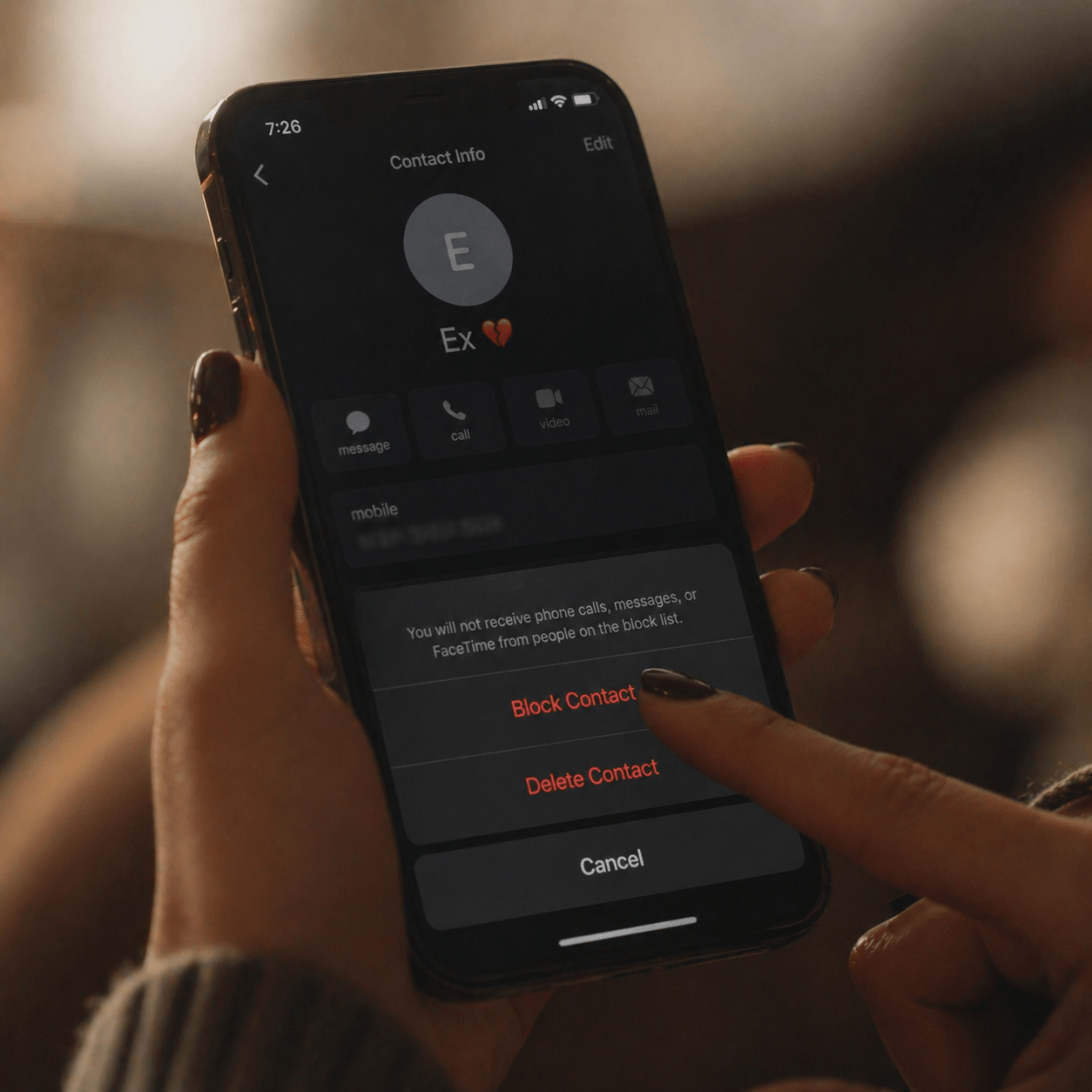
We've been culturally trained to treat the block button like a dramatic, last-resort move. In reality, blocking is a tool for emotional hygiene, not a declaration of war.
Here's what blocking him actually does at the end of a relationship:
1. Removes temptation — you can't check what you can't see
2. Signals to your nervous system that the relationship is truly over
3. Stops the loop of monitoring his activity for clues about your worth
4. Prevents the 2am text you will regret by morning
5. Creates the space your brain needs to form new neural patterns
Think of the block button as a circuit breaker. It doesn't mean you hate him. It means you've chosen yourself.
What No Contact Does to Him (And Why That's Not the Point)
Yes, people will tell you that the no contact rule "makes him want you back." And sometimes, that happens. But making it about him is the trap.
When you go no contact because you want a reaction, you're still handing him the power. The goal is to want no contact because you need it — regardless of what he does next.
That said: silence is often more eloquent than any message you could send. It communicates self-respect in a way that long, emotional texts never can.
When you stop pursuing and start investing in yourself, something shifts — and it's not just his perception of you. It's yours.
Building Your No Contact Protocol: A Practical Checklist
Ready to commit? Here's your 2026 no contact starter kit:
Step 1: Go full block — not mute. Mute is a half-measure. Block on Instagram, TikTok, X, Snapchat, LinkedIn, Spotify, and anywhere else you're digitally connected.
Step 2: Remove his number from your phone. Don't just save it under "DO NOT CALL." Delete it. You know it by heart anyway, and that's a problem to solve in 30 days.
Step 3: Ask mutual friends for space. You don't need to announce a break up publicly. Simply let close friends know you're in a no-contact period and you'd prefer not to receive updates about him.
Step 4: Create a "urge plan." When the urge to reach out hits (and it will), have a pre-decided action: call a friend, go for a run, write in a journal. Replace the behavior, don't just suppress it.
Step 5: Set a review date — not a "get back together" date. In 30 days, you check in with yourself. Not with him. You assess how you feel, what you've learned, and what you want. The relationship is the past. You are the variable.
The End of a Relationship Is Also a Beginning
The break up is not the end of your story. It is, however, the end of a chapter that was written for two people — and now you're the only author left.
The no contact rule gives you the silence to hear your own voice again. It gives you the space to remember who you were before you shaped yourself around someone else.
Blocking him is not giving up. It is choosing forward.
In 2026, with infinite ways to stay digitally tethered to someone who is no longer yours, the most radical act is to close all the tabs. Close them, log out, and build something worth coming back to — yourself.